Showing posts with label GMA Network. Show all posts

Ultraman Tiga | GMA Network 90s Filipino-Dubbed Tokusatsu

Ultraman Tiga was a Filipino-dubbed superhero kids show that aired in GMA Network every weekdays at 4:30 PM during the late 90's from January to July 1999. Ultraman Tiga Ultraman Tiga (ウルトラマンティガ Urutoraman Tiga) was a Japanese tokusatsu series and the 11th show in the Ultra Series. Ultraman Tiga was produced by Tsuburaya Productions originally ran from September 7, 1996 to August 30, 1997 with a total of 52 episodes and with 5 movies. Let's go down memory lane and remember Ultraman Tiga.

Ultraman Tiga late 90s Philippine Television Run on GMA Network Retro Pilipinas Feature

Ultraman Tiga - The Story
About Ultraman Tiga

Ultraman Tiga is a show set in an alternate universe in the year 2007-2010 wherein giant monsters and conquering aliens started appearing as was foretold by an apocalyptic prophecy. The Terrestrial Peaceable Consortium (TPC) along with its branch, the Global Unlimited Task Squad (GUTS) was created in response to this threat.

With the help of a holographic message in a capsule found by researchers, the GUTS where able to come by the knowledge about a golden pyramid built by an ancient civilization. Three statues of a race of giants who defended early human civilization on Earth about 30,000,000 years ago was present in the site. GUTS discovered that two of these were destroyed with the third one gaining 'life' from the spiritual energy of officer Daigo who happens to be a descendant of the ancient race. Daigo and the remaining statue merge into a single being, made of light. Defeating the two monsters responsible for destroying the other two giant statues, Daigo is later revealed by the hologram of the prophecy that a great evil that not even the giants could stop destroyed the ancient civilization 30 million years ago.

Ultraman Tiga and Ultraman Shakes Hands

Ultraman Tiga Opening Theme
Ultraman Tiga Series Intro


"Take Me Higher"
Performed by V6
Japanese Lyrics: Kazumi Suzuki
Arrangement: Yasuhiko Hoshino
String Arrangement: Mitsuo Hagida
Choral Arrangement: Hiroaki Suzuki

Ultraman Tiga Closing Theme
Ultraman Tiga Series Outro


"Brave Love, TIGA"
Artist: Earth Protection Force
Lyrics: Sunplaza Nakano
Composition: Barbe-Q Wasada
Arrangement: Yasuhiko Fukuda

Ultraman Tiga Philippines Ultra Man Tiga Scenes in GMA Network Philippine TV Run of Tiga


What can be said about Ultraman Tiga's run on GMA Network back in the late 90s? Well, as a 90s kid I can only remember that it was one awesome UltraMan series that featured a multi-formed or multi-suit Ultraman which was not observed in other Ultraman that came before it; well at least that was shown televised here in the Philippines back then. Well, besides that, I have vivid recollection of the story itself. Although the ending theme 'Brave Love, TIGA' has always been stuck in my memory. When making this look back, I thought that it was the opening as to how cool it sounded back then and still is now. when this ended it was later followed up by Ultraman Dyna which was picked up by rival network ABS-CBN. I think I will re-watch this series along with dyna as back then, we haven't had the internet or local stations didn't picked up the five movies that according to information online came out from this series. Who wouldn't want to see Dyna and Tiga in one movie, right?

Ultraman Tiga title card Retro Pilipinas feature on Tsuburaya Productions 11th Ultraman Series

How about you guys, do you have any memorable moments, episodes, experiences, or merchandise from this nostalgic Ultraman series? Share your thoughts and opinion about Ultraman Tiga's run in Philippine television back in the late 90s in the comments section below and let's discuss:
Read More

Hell Teacher Nube | Jigoku Sensei Nube | A GMA 90s Filipino-Dubbed Anime Retrospective

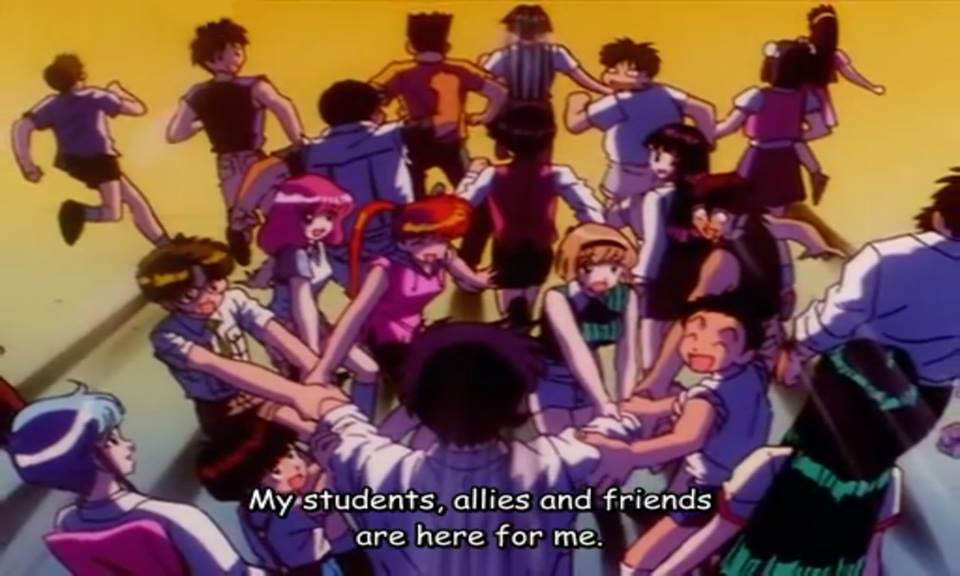
Hell Teacher Nube was a Filipino-dubbed anime which aired in GMA network's prime time television block during the late 90s in the Philippines. Hell Teacher Nube was originally titled Jigoku Sensei Nube that originally run from April 13, 1996 to August 7, 1997 on TV Asahi with a total of 49 episodes. Jigoku Sensei nube was first a manga written by Makura Shō and illustrated by Takeshi Okano published by Shueisha for the Weekly Shōnen Jump Magazine that originally run from September 1993 – May 1999 with 31 volumes. Let's go down memory lane and remember Hell Teacher Nube.

Hell Teacher Nube GMA Network 90s Filipino-Dubbed Anime in Philippines Retro Pilipinas Feature

Hell Teacher Nube - The Story
Hell Teacher Nube Series Plot

Nueno Daisuke, a new teacher moving into Domori Elementary School. Nueno Daisuke, often simply called Nube is an both a warm and caring professor and a yokai "expert" and exorcist. Trouble seems to follow Nube as he must learn to contend with being a guiding and inspirational figure to his students and his colleagues and fend off any yokai that dare harms them.

Jigoku Sensei Nube Nueno Meisuke 5-3 class teacher and yokai exorcist

Nūbē is usually forced to action when various yokai threatens and endangers his beloved students. Nube often use the power of the Demon's Hand (Oni no Te) to assist in solving the problem for the particular episode. The series follows an episodic format featuring different monster or yokai each episode which helps flesh out each characters in the show.

Hell Teacher Nube Opening Theme
Jigoku Sensei Nube Series Intro


"Baribari Saikyou No. 1" (The No. 1 Greatest Hard-Worker)
Performed by Feel So Bad

Hell Teacher Nube Closing Theme
Jigoku Sensei Nube Series Outro


"Mienai Chikara ~Invisible One" (Unseen Power ~Invisible One)
Performed by B'z

Nueno Meisuke in Jigoku Sensei Nube of Domori Elementary School

What is there to say about Hell Teacher Nube? Well, Hell Teacher Nube was one of those nostalgic anime that indirectly educated 90s kids (like myself that time) life lessons. It highlighted and taught about the value of friendship, respect, competitiveness, and valuing what matters most in life. Looking at it now, I personally find anime (thru this series) very fascinating as how effective it is as a form of entertainment and instrumental to shaping the minds, values, and morals of the youth. It has the perfect mix of humor (sometimes "naughty" humor) and seriousness which gives respect to the intellectual capacity of kids. I believe that it is better to not dumb down various shows in order to educate the children and it is up to parents to help and guide them through it. Hell Teacher Nube was also awesome and action packed thanks to the monsters featured each week which are usually "subdued" by the demon (oni) sealed in his left hand.

Domori Elementary School of Class 5-3 Students Under Nueno Meisuke - Hiroshi Tateno, Kyoko Inaba, Miki Hosokawa, Katsuya Kimura, Makoto Kurita

As a kid growing up in the 90s, there wasn't a single episode that I dare miss in Hell Teacher Nube's GMA Network television ran back in the late 90s or early 2000. Feel free to correct me about this if you know exactly it's original run here in the Philippines. Hell Teacher Nube was one of the five anime which was put into the primetime block (Mondays to Fridays at 7:00 or 7:30 PM) back in the days. A very bold and admirable thing by a television network when you look at it now. Back then, I could say that it was better that GMA took its younger audience seriously and featured anime first before getting on with the usual adult stuff like soap operas or movies. Looking at how television now, I somewhat miss those days. Now all kids have are those cliche'd local telenovelas that dumbs them down forcing morality, subliminally teaching them promiscuity not backed up by good sex education, and be "drama" kinds and queens. But I am digressing, we'll leave the state of television and social commentary for another day.

Favorite Jigoku Sensei Nube is  episode 47 about Nueno Meisuke against the god  yokai of poverty and friendship

Hell Teacher Nube episode 47 about Teacher Nube versus the god of poverty  and having friends to be always there for him


I remember doing sketches featuring Hell Teacher Nube characters in my notebook. Just recently I was able to relive what made it click as I re-watch Hell Teacher Nube episodes online (you can check out the series on the link there). There is also a Hell Teacher Nube Live action series available online if you are also interested. After re-watching the anime series, one particular episode stood out to me. It was Jigoku Sensei Nube episode 47 which was entitled "Strongest! Greatest! The final enemy! And his name is...God of Poverty!!" I will not spoil it for you but I highly recommend that you see it.

Hell Teacher Nube Title Card Filipino Dubbed Japanese Anime Jigoku Sensei Nube Aired in the Philippines

How about you guys? Did you remember how Hell Teacher Nube was like back in the days? Did you like the series or have other anime's in that GMA Anime Primtime block that you prefer (Monster Ranger, Master of Mosquiton, Vission of Escaflowne, etc.)? do you have any particular favorite episode, characters, yokai, merchandise, experiences and memories related to the show? Share your thoughts and experiences about Hell Teacher Nube in the comments section below:
Read More

Takeshi's Castle | An IBC 90s Filipino-Dubbed Japanese Game Show Retrospective

Takeshi's Castle was a syndicated game show originally from Japan which was Tagalized (dubbed in Filipino) hosted by Anjo Yllana as Takeshi and Smokey Manoloto as "Iwakura" providing the commentary with a gravelly Japanese accent. Takeshi's Castle or Showdown! Takeshi Castle originally Japanese game show that aired between 1986 and 1989 on the Tokyo Broadcasting System which featured Japanese actor Takeshi Kitano a.k.a. Beat Takeshi as a count who owns a castle and sets up difficult challenges for players to get to him. Let's check out this comic and phenomenal game show that took the world by storm. Let us go down memory lane with Takeshi Castle Philippines.

Takeshi's Castle 90s Filipino Dubbed Japanese Game Show Retro Pilipinas Feature

Takeshi's Castle - The Show
About Takeshi's Castlet

Takeshi's Castle is a comic game show which involved between 100 and 142 contestants whom General Tani "forced" into a series of batch physical challenges, eliminating many who fail to meet its requirements. Each show finished with a "Final Showdown" where Count Takeshi will face the remaining contestants. In early episodes the finalists (contestants) would storm the castle itself and engage in a short-range water gun assault. Later episodes introduced carts with paper rings, and eventually lasers and light-sensitive targets. If the contestant's gun penetrated the paper ring or hit the sensor on Takeshi's cart, against such weapons as a large water gun and a laser-armed plane, Takeshi's cart was deactivated, the castle was "taken" and the game "won". The player who stopped Takeshi won one million yen which at the time, amounted roughly to 8,000 US dollars. However, because of the seemingly unbeatable challenges issued by the show, there were only a handful of nine winners during the show's run.
The series featured extensive landscaping of a fixed campus at TBS-owned Midoriyama The final regular episode aired on April 14, 1989 followed by several one off specials.

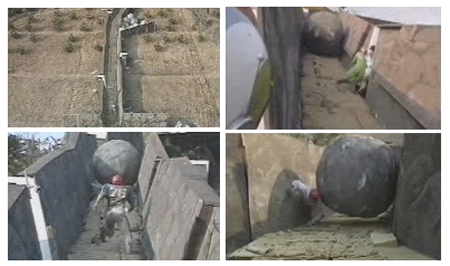
Takeshi's Castle Philippines Avalanche Challenge Retro Pilipinas

In the Philippines, Takeshi's Castle was first shown on the Intercontinental Broadcasting Corporation TV network in October 1990 as a Tagalog-dubbed show. Later episodes contained interludes shot on a studio with actors Anjo Yllana as Takeshi and Smokey Manoloto as "Iwakura" providing the commentary with a gravelly Japanese accent, which was later dropped in favor of their natural voices. The Filipino production crew also developed on the relationship of the commentators, with Iwakura often trying to trick Takeshi on several occasions. The show was later re-run with with new commentators like in Takeshi's Castle 2006 QTV rerun featuring new characters giving commentary. QTV's Takeshi's Castle included fictional characters like Shogun Shintaro "Taru" Gokoyami (Joey de Leon) who is Takeshi's right hand man and sumo wrestler Kakawate Takehome (Ryan Yllana - brother of the original Filipino version of Takeshi's Castle, Anjo Yllana), the leader of the Takeshi Gundan.

Best of Takeshi's Castle
Takeshi's Castle Gameplay Series


As a kid growing up in the 90s I can still remember how the whole family was entertained by the localized version of Takeshi's Castle. Thanks to the power of the internet we can repeatedly go down memory lane and re-watch segments of the popular classic game show. Almost every challenges are hilarious in their own right. Avalanche throws the contestants in a big challenging climb where they should evade incoming boulders through a number of "crevices" or cracks on the side of this foamy slope. There was also the Devil's Maze which was also known with a few names (internationally) like the Square Maze or Honeycomb Maze where the participants need to pick the right door and to stay up their feet to evade the demons out to oust them from play. There is also the Bridge Ball which requires great balance and wits to overcome. Evade the rubber canon balls blasted at you while you make your way on a narrow wooden bridge. Then there is the very nauseous Flying Mushroom. The Final Fall before the Final Showdown is a game of chances to pick three right holes leading to the final showdown challenge with the risk of entering the wrong hole leading to a disqualification from the game. Then there's the Final Showdown.

Takeshi's Castle Final Fall

I've always wondered if how did the show managed complaints from its participants or to whether they got sued or something for various physical injuries the participants received from the show, but I guess it was part of the contract the participants signed if there were any. Takeshi's Castle is still up to this day one of the best and hilarious game show where shows like Wipe Out draw inspirations from. How about you guys, what's your most memorable challenge or skit from the Philippine Takeshi's Castle? Share your thoughts about Takeshi's Castle in the comments section below:
Read More

Batibot | A PTV 80s Educational Show for Children Retrospective

Batibot was a popular Filipino children's television program based on Sesame Street. Batibot, a Filipino word which directly translates to "small, but strong and robust" premiered in May 14, 1984, with the name Sesame! which was eventually renamed to Batibot several years later. Batibot used both English and Filipino as the media of communication back when it was still Sesame! but became a completely Filipino language children's educational show once it transitioned to Batibot. Batibot broadcast nationwide from Monday to Friday on the Philippine television networks Radio Philippines Network (RPN) from 10:00 to 11:00 a.m. and on People's Television (PTV) (now National Broadcasting Network) from 3:00 to 4:00 p.m. In 1991, the show switched to ABS-CBN but switched back to RPN in 1994 after the former decided to produce its own set of children TV programs through the ABS-CBN Foundation. In 1995, PCTVF signed a contract with GMA Network and Batibot was shown at its original morning time slot. It ran from May 14, 1984 – June 30, 2002 and later came back on TV5. Let's go down memory lane as we remember Batibot.

 Retro Pilipinas Feature

Batibot - The Show
About Batibot

Batibot featured both humans, muppets, and mascots as its main cast of characters. batibot is one of the Philippines' longest running educational kids program. The original Batibot human cast included Kuya Bodjie, (played by Bodjie Pascua), Batibot's resident story-teller know for his opening line "Mga Bata..." when starting with his stories; Ate Sienna (Sienna Olaso) a college student; Kuya Mario (Junix Inocian); Ate Isay (Isay Alvarez-Seña) popular for her "Kapit-bahay" music; and Kuya Ching (Ching Arellano), Batibot's resident jeepney driver.

BATIBOT Television Special and Original Cast Reunion

In 2007, A Batibot Reunion and Tribute Special was featured in a segment in Kapuso Mo Jessica Soho. Check it out here fellow Batang Batibot(s).


Some of Batibot's most notable muppet/mascot cast included Pong Pagong, a clumsy, pink full-body turtle wearing a baseball cap from Jose Rizal's story of "Ang Pagong at ang Matsing"; Kiko Matsing, a brown monkey version of Sesame Street's Oscar which is also Ang Pagong at ang Matsing; Koko Kwik-Kwak, or Koko for short that wears an ethnic-inspired beanie cap with a propeller made of green leaves; Manang Bola, the forgetful fortuneteller who still relies too much on her crystal ball named "perlas na bilog,". She divines the future by chanting "Bolang bilog, huwag patulog-tulog; sabihin ang sagot" and "ba-be-bi-bo-bu", teaching vowels in the process; Sitsiritsit and Alibangbang, two inquisitive space aliens who take delight in discovering things, places and people around them. Inspired from the nursery rhyme "Sitsiritsit, Alibangbang"; Ningning and Gingging*, the sisters. Ningning is the eldest girl, the serious type, while Gingging is younger and the playful one between the two siblings; and Kapitan Basa*, a superhero that loves to read. He solves language-related problems caused by his arch-nemesis, Patlang-Palit.

Batibot Opening Theme
Batibot Show Intro


Batibot Theme Song Lyrics

Pagmulat ng mata,
Langit nakatawa
Sa batibot,
Sa batibot
Tayo nang magpunta
Tuklasin sa batibot
Ang tuwa, ang saya

Doon sa batibot
Tayo na, tayo na
Mga bata sa batibot
Maliksi, masigla. (2x)

Dali, sundan natin
Ang ngiti ng araw
Doon sa batibot (2x)

Tayo nang magpunta
Tuklasin sa batibot
Ang tuwa, ang saya

Doon sa batibot
Tayo na, tayo na
Mga bata sa batibot
Maliksi, masigla. (2x)

Iconic Batibot Philippine Educational Children's Television Show Cast

I am one of those Batang Batibot Kids who usually takes a break from the usual censored violence of US animated shows and Japanese anime(s). Everyday was Batibot Day with Kuya Bodgie reading us stories with matching illustrations, the angelic voice of Ate Isay, the gruff voice of Kiko, and the playful Pong. 90s kids connected and related to Batibot because that is one of the only educational shows presented in Filipino which make it stand out from Sesame Street and the countless of animations which are usually dubbed in English. Well, this is probably just me growing up fascinated with puppets but back then they were really a good source of rich colorful information and imagination. Well we now have the internet for that. For people who grew up with Batibot, they will forever be in our hearts and minds. How about a home video compilations to give our kids a chance?

Batibot Filipino Educational Children's Television Program GMA 90s Billboard Banner

How about you guys, were you a Batang Batibot? Any favorite muppet, mascot, human character, segment, music, story or mercandise you want to share? Let us here your thoughts about Batibot in the comments section below:
Read More

Bitoy's World | A GMA Network 90s Educational Show Retrospective

Bitoy's World was a Filipino educational comedy show hosted by Michael V. playing as Etoy, Betong and Bebang featuring clips from Ripley's Believe It or Not. The show replaced Bitoy's Adventures in Bilibkaba? in 1997-1998 which also replaced Bilibitornot (1996-1998) which are all hosted by Michael V. using clips from the documentary television series Ripley's Believe It or Not. Bitoy's World aired every Sunday night from 1998 to 2001 in GMA Network. Let's go down memory lane and remember what this GMA Network infotainment program was like.

Bitoy's World GMA Network 1998 - 2001 Retro Pilipinas Feature

Bitoy's World - The Show
About Bitoy's World

GMA Network's Bitoy's World is just a variation of Bitoy's Adventures in Bilibkaba? and Bilibitornot with one change in particular, its hosts. Besides the weird and informative clips from Ripley's Believe It or Not, it also focused on the weird relationship of its hosts, the sibling Betong and Bebang, with their bullied neighbor ("friend"), Etoy.

Michael V in Bitoy's World 1998 - 2001 GMA Network

Michael V. plays all three parts in a green screen to give the effect that the three characters are all together in one screen, interacting. The show usually feature Bebabng or Betong bullying Etoy reminiscent of Looney Toons cartoons' Wile E. Coyote and Road Runner.

Bitoy's World - Opening Theme Lyrics
Bitoy's World Intro Lyrics

Ahoy! Ahoy!
Meron akong balita
Meron kaming show at kaming dalawa ang bida
Para sa bagets
at para sa gurang
Si Betong, Si Etoy
at ako si Bebang

Beh Baby,
Beh beh beh beh Baby
Beh Baby,
Beh beh beh beh Baby

Si Betong, Si Etoy
at ako si Bebang.

Bitoy's World Michael V as Bebang


Making this post is really challenging especially as I had a hard time finding clips or even photos of Bitoy's World. Luckily I found this pic of the three host of Bitoy's World together with Director Uro dela Cruz in Flickr. This made me realize the importance and why I made Retro Pilipinas blog. It is to scour the internet for any materials of the show that I grew up with. Well, it is much easier for me to archive some of the international shows shown in our country because some of these shows have either dedicated sites created by fans or enough materials have written about them. So when I was looking for Bitoy's World, I usually ended up with nothing. But the memories of the Bitoy's World are still here. The show was so fascinating back when I was still in high school which made me decide to make three characters out of my main character in my notebook log. The show was that hilarious and influential to me back then. Too bad I didn't have any more materials to share it with you guys. So if ever you have one, you can share it here.

Bitoy's World Michael V as betong, Etoy and Bebang with Director Uro dela Cruz

How about you guys, what's your fondest memory of Bitoy's World? Any particular memorable story, memorabilia, moments, or characters of the show that you want to share? Share them along with your thoughts about Bitoy's World in the comments section below:
Read More

That's Entertainment | GMA 80s Filipino Teenage Variety Show

That's Entertainment or simply known as "That's" was a Filipino youth-oriented talent and variety show that aired in GMA Network from January 6, 1986 – March 23, 1996. That's was hosted by German Moreno together with Ike Lozada. Let's go down memory lane with That's Entertainment here at Retro Pilipinas.


That's Entertainment Filipino youth variety show Retro Pilipinas Feature


That's Entertainment - The Show
About That's Entertainment

That's Entertainment launched on January 6, 1986 by GMA Network and first aired from the old GMA building in EDSA, but later moved to the GMA Broadway Centrum in 1987 to accommodate it's increasing studio audience and fans. The Filipino youth variety show used song "That's Entertainment" as its main theme song. That's Entertainment was written by Arthur Schwartz with the lyrics of Howard Dietz which was written especially for the 1953 Metro-Goldwyn-Mayer musical film The Band Wagon. Hosted by German Moreno together with Ike Lozada, That's gained popularity almost overnight among young Filipino audiences.


That's Entertainment ushered in new stars whom most have become the Philippine industry's finest. The youth-oriented variety show grouped their talents into five: Monday, Tuesday, Wednesday, Thursday and Friday groups. Every Saturday, all of the said five groups were joined together to performed various production numbers. The show paired up various talents to serve as love teams that usually illicit feelings of "kilig" to most of the show's female audiences. The pairing eventually transcended the show and some eventually hooked up in real life. The show was a star maker, those who were exceptional and offered something fresh became the industry's finest celebrity idols. Nobody can be young forever. That's members eventually moved on with their lives. Some got their much needed industry break making them the industry's popular actors, comedian/comedienne, actors, singers, dancers, and performers. Some decided to pursue a much fulfilling and private lives completely vanishing from the radar of the ever scrutinizing eye of the public. The show also catapulted different dance group to popularity, The Maneouvres, Streetboys, Abztract Dancers, Kids at Work, UMD all became the Philippines' premiere dance group because of the show. German "Kuya Germs" Moreno was recognized as the Philippine's star maker because of the said show.

That's went off the air at the height of its popularity back in March 23, 1986. The last episode of "That's Entertainment" was shown on Saturday primetime (9:00 pm) with former members reunited in a TV special entitled "That's The Reunion".


A Fan Tribute Video to That's Entertainment:


I wasn't really that into That's Entertainment that time. I was but a kid back then and had really no interest in an afternoon variety show. But I have to give credit to the show for discovering and launching the career of their talents who most have become the popular celebrities, politicians and professionals in the Philippines and even abroad. I was really not a That's kid, but it will forever have a special place in the hearts of those who supported the show.


That's Entertainment Filipino youth variety hosted by German Moreno Kuya Germs and Ike Lozada


What about you guys? Were you a fan of That's Entertainment? If you were, then what's your fondest memory, favorite love teams, favorite talent and general thoughts on the iconic star maker of a variety show from GMA Network back in its 80s-90s run? Share your thoughts on That's Entertainment on the comments section below:
Read More

Okey Ka, Fairy Ko! | An IBC 80s, ABS-CBN 80s - 90s, GMA Network 90s Filipino Sitcom Retrospective

Okey Ka, Fairy Ko! was a popular Filipino television situational comedy (sitcom) that first premiered on the Intercontinental Broadcasting Company or IBC 13 and ran from 1987-1989, transferred and continued its run on ABS-CBN from 1989-1985, and finally getting cancelled after two years of its GMA Network run when the show transferred there. The show focuses on the Kabisote family mainly Enteng and Faye as they struggle with everyday normal life and the magical life of Faye being the Princess of the land of faeries, Engkantasya. Let's go down memory lane and reminisce this phenomenal Philippine retro sitcom about family, magic, and the never-ending fight of good versus evil.

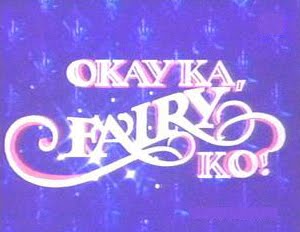
Okay Ka, Fairy Ko! 80s - 90s Sitcom Retro Pilipinas Feature


Okey Ka, Fairy Ko! - The Story
Okey Ka, Fairy Ko! Synopsis

Vicente Kabisote, Jr a.k.a Enteng Kabisote (played by Vic Sotto) was trying to outrun a woman who is forcing him to marry her through the threats of her muscled brothers. To escape this persistent woman, Enteng adopted a street-child named Aiza (Aiza Seguerra) and pretended that he already has a daughter from a previous marriage, but even so, the obsessed woman still pursued Enteng. Unknown to the Enteng, he is being watched from a by the magical kingdom Engkantasya's fairy Princess Chloroteam who will later be known as Faye (Alice Dixson). She immediately fell in love with the nimble mortal and magically transported him to Engkantasya while he sleeps. Like Faye falling for him, the same happened to Enteng after seeing Faye. They later returned to the mortal world to get married with Aiza as the loving couple's witness. As much as the queen of Enkantasya's Ina Magenta (Charito Solis) disapproves of Chloroteam (her heir to the throne of Engkantasya) marrying a nimble mortal, she knows that he is a man who truly loves her daughter and her daughter loves him as much. She usually meddles with the affairs of the couple now trying to live as magic-free as possible but it can not do so as forces of evil from Engkantasya tries to overthrow Magenta by hurting her one and only daughter, Faye and her family.

Each episode features the everyday struggles of Enteng, Aiza and Faye as they deal with everyday family issues and from the evil of Luka, and reyna ng kadiliman (Luz Valdez). To add up to the magical world of Okay Ka, Fairy Ko! are some few supportng characters. Amy (Ruby Rodriguez), the nosy yet trustworthy housekeeper of the Kabisotes who usually gets her memories constantly erased by the show's fairies (mainly Faye and Magenta) everytime she discovers the magical nature of the people she work for. Bale (Jinky Oda), the store-owner just adjacent to the Kabisote's house is a friend of Amy who she usually share a lot of gossips with. Pipoy (Larry Silva) is Enteng's bald and beer-bellied assistant in his repair shop. Prinsipe ng Kahilingan or Prinsipe K (Bayani Casimiro Jr.) is a tap dancing and blunder of a wish-granting fairy known on the series for his outrageous tap dancing entrances whenever he is called.

Okay Ka, Fairy Ko's main theme song is "Fireworks" by Alan Menken from Walt Disney's film adaptation of The Little Mermaid. It is hard to come by any online of videos of the the original epsiodes or even the theme of Okay Ka, Fairy Ko! so here is "Fireworks" by Alan Menken and just imaging the show opening with it.

Okey Ka, Fairy Ko! 80s - 90s Sitcom Television Theme
Okey Ka, Fairy Ko! Theme from Alan Menken's "Fireworks" (The Little Mermaid)


Okay Ka, Fairy Ko The Movie 1991


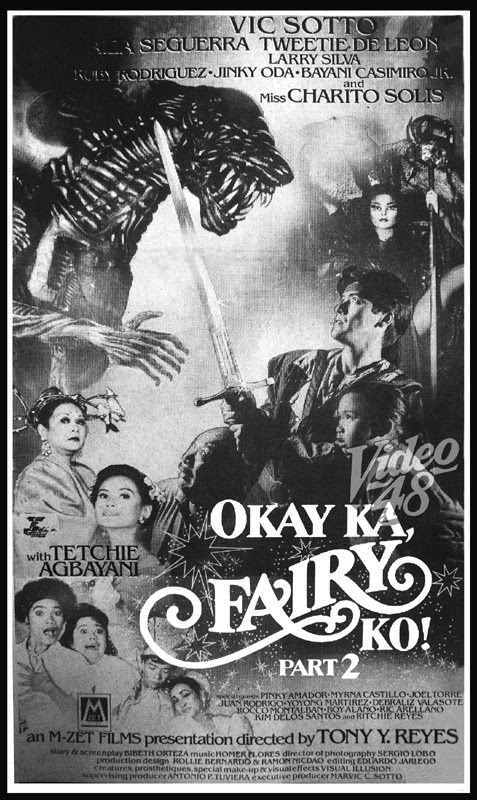
Okay Ka, Fairy Ko Part 2 1992 movie

Okay Ka, Fairy Ko! Classic Movie Posters from Video48.
Check them out for a more in-depth look on classic Filipino films.


I liked the show back in the 90s and this is probably why up to today I am still able to enjoy the absurdity of this era's Enteng Kabisote film series. I literally grew up watching this series and fell in love with a sitcom that focused on family, love, and a fantasy world of fairies, witches and magic. To someone who never knew other foreign shows back then like the classic Bewitch US series, which I think might probably be the show where this Filipino sitcom draws its inspiration from, Okay Ka, Fairy Ko! was a good sitcom for a growing up 90s boy. The Faye that I am familiar with is the Tweetie de Leon and the Roderick Paulate version. Fans of the series knew that the series was known for changing its female lead and the show made up this lore that fairies usually undergoes this "makeover" which doesn't always bear good results. This has later been carried out in the Enteng Kabisote film series. Okay Ka, Fairy ko! has two movies back in the 90s and like today, both are heavily marketed on the longest running noontime show Eat Bulaga. My most memorable Okay Ka, Fairy Ko - Eat Bulaga contest was probably with the movie where Pipoy was eventually turned into a human-turtle as a means of transportation. They used some pretty clever use of the Pipoy "animatronics" head as it is attached to the life-size turtle's fake body. Okay Ka, Fairy Ko! will forever be remembered as one of the best Filipino sitcoms of all time.

What about you guys? What are your fondest memory of Okay Ka, Fairy Ko! ? How about the two movies it spun back in the 90s? Any favorite episode and characters? Share your thoughts in the comments section below:
Read More

Ober Da Bakod | A GMA 90s Sitcom Retrospective

Ober Da Bakod was a popular GMA Network sitcom produced by Viva Television and co-produced and broadcast by GMA Network from 1992–1997. The weekly situational comedy features the misadventures of two brothers Mokong and Bubuli as they successfully overcome every devious plans created by the sinister and filthy rich father of the two girls that they are courting. Let's go down memory lane and reminisce this hilarious Philippine retro sitcom.

Ober Da Bakod GMA Network 90s sitcom retro pilipinas feature


Ober Da Bakod - The Story
Ober Da Bakod Synopsis

The brothers Mokong (Janno Gibbs) and Bubuli (Anjo Yllana), sons of Lucring Dayukdok (Malou de Guzman) have feelings for the rich sisters Honey Grace (Gelli de Belen) and Barbie Doll (Donita Rose), daughters of the infamous Don Robert Dinero (Leo Martinez); Mokong for Honey Grace and Bubuli for Barbie Doll. Don Robert doesn’t like the brothers because they are poor. In order to freely court Honey Grace and Barbie Doll, Mokong and Bubuli climbs over the fence and thus the title Ober Da Bakod (Over the Fence).

Don Robert, usually with the aid of his blundering fool of a right hand man, Brownie (Danny Pansalin) always makes plans to prevent Mokong and Bubuli to get close to his daughters. Nonetheless, he fails due to the intervention of his mortal enemy and former girlfriend, Aling Lucring who happens to be Mokong and Bubuli's overprotective mother. As a result, total mayhem ensues between the two families. A running gag of the series is that in the end of every episode, two policemen, Officers Tedera and Officer Ginto, arrest Don Robert fbased on whatever schemes he had concocted. As Don Robert tries to explain his way out of this arrest, the police officers always tell him, "Sa presinto ka na lang magpaliwanag." ("Explain everything at the precinct.") Those words have now become a semi-common Filipino catchphrase.

Ober Da Bakod has a hip and catchy opening theme also entitled "Ober Da Bakod" was written and performed by 90s popular comedic actor and Filipino rapper Andrew E. I can not find the exact opening theme for the popular Philippine sitcom, only this movie theme song of Ober Da Bakod:

Ober Da Bakod 90s Sitcom Television Theme
Ober Da Bakod written and performed by Andrew E


Ober Da Bakod The Movie VHS Cover


The sitcom spun two movies under its 90s run mainly Ober Da Bakod: The Movie (1994) and Ober Da Bakod 2 (1996). I personally consider this as one of the most hilarious 90s sitcom. The chemistry amongst the comedy show's cast flowed naturally which made the humor much more natural, if not effortless. Aling Lucring was the perfect representation of a probinsyana Filipino tiger mom usually to her elder son Mokong whom she usually smacks her mischievious son at the back of his head (accompanied by a hitting a frying pan sound effects) everytime Mokong commits a mistake, teasing his younger brother Bubuli, or just to complete her day. I can somehow relate to Mokong although my mom didn't hit me in the head to discipline me back then, she sure is a probinsyana tiger mom. Just like Aling Lucring's signature frying pan hit, every episode would not be complete without Don Robert getting arrested. If there was something that the show thought us (children in the 90s) it was that crime or doing harm against people will always get you in trouble with the law, specifically the police. Even in the two Ober Da Bakod movies, Don Robert was still man-handled by the two arresting police officers before the film cut to its ending credits.


Here is an idea of what Ober Da Bakod was like back in the days, a Youtube clip of best of Ober Da Bakod the Movie. Although the TV sitcom was way much better than its movie counterparts.


What about you guys? What are your fondest and most memorable momments of the GMA Network sitcom Ober Da Bakod? share your thoughts in the comments section below:
Read More

Pintados | GMA 90s Filipino Superhero Show

Pintados, Painted Ones is a Philippine action-adventure super hero television series from GMA Network which ran from September 1999 – April 2000. Pintados follows five ordinary teenagers from all walks of life who also came from families victimized by heinous crimes. The five teenagers were trained in various armed and technological combat and ultimately became part of a secret crime fighting group to preserve, protect and fight for justice.


Pintados GMA Network Super Heroe TV Series Retro Pilipinas Feature


Pintados - The Story
GMA Network's Pintados Plot

After several rich Filipino families become victims of terrible crimes, they agree to set up and fund a foundation to battle the criminals. Under the command of "Guro", an unsanctioned agency of the government sets up a clandestine crime fighting unit. Each of the members is themself a victim of hideous crimes. This elite unit taken from all walks of life take a leaf from Filipino warriors of old, and cloak themselves in armour, ethnic war paint and tattoos, gaining the name "The Pintados" (Painted Ones). Opposing Pintados is the army of the human/reptile hybrid Katana.


Pintados 1999-2000 Pinoy TV Super Hero Group


The Pintados are mentored by Guro (Robert Seña). The Pintados is comprise of Daniel Cervantes a.k.a. DATU (Michael Flores), a swordsman with Kris as his main weapon, a master of Jui-Jistu, and is able to project an energy wave "Enerhiyang Alon" that is capable of knocking people out or blasting through objects; Reewa Zulueta a.k.a. DIWATA (Angelica Dela Cruz), skilled thai kick boxer, has a neutraliser whip as her main weapon, and uses the "Salaming Salamanka" Holographic Imager that is capable of emitting both convincing holograms and holographic force fields; Antonio Sto. Domingo a.k.a. TATTO (Vandolph Quizon), computer expert and genius, uses a Taser Blaster and a Titanium Yo-yo, he uses his stealth shield generator, the "Kalasag ng Hunyango" Chameleon Shield; Maya Feliciano a.k.a. MAYUMI (ASSUNTA DE ROSSI), skilled in Aikido, uses of Nunchuks and is also armed with a yellow laser -the Yellow Flame; and Pido Zapata a.k.a. KIDLAT (Sherwin Ordoñez), specialist in street fighting, armed with the "Latigong Kidlat" Electromagnetic Pulse Blast which can disrupt any electronic or mechanical devices in it's blast radius. Their villains roster includes Anak Araw - Albino Crime Syndicate leader, Manananggal, Katana - a human-reptile hybrid, Dr. Virus, Damarama, Uno Dos Tres, and Thundara.


Pintados Datu, Diwata, Tatto, Mayumi, Kidlat


Pintados could very well be the first time that GMA Network adapted the fantasy series genre, not to mention adapting the popular super sentai series format of Japan. Just look at them, a group comprises of five teenagers transforming into crime fighters. Pintados also featured a kick-ass opening theme from Philippine's Master rapper himself, Francis Magalona. Too bad as I haven't seen any Pintados opening theme videos over at Youtube.


Pintados GMA Network Series Retro Pilipinas Pintados Show Title Logo


What are you fondest memory or how about most memorable episode of Pintados? Share your thoughts about Pintados in the comments section below:
Read More